The Interface Is Changing. The Business Still Has to Run.
People are starting their work by asking AI instead of opening software. The business systems underneath matter more, not less. Here is how to build the governed operating layer that lets AI work inside a real organization.
AI is becoming the front door to business work, and business applications are becoming the infrastructure behind it. That makes the operating layer between them, with its roles, rules, permissions, approvals, and audit trail, the part that decides whether AI helps or just speeds up the disorder.
For years, businesses bought applications and trained people to operate them. Employees learned which system held the customer record, where the projects were managed, where the reports were generated, and which screen to open for which task. Knowing the software was a large part of knowing the job.
That arrangement is starting to loosen. More and more, people will begin their work by asking an intelligent system to do something: prepare the client briefing, find the accounts that need follow-up, review a contract, explain what changed in the numbers. The interface is moving away from software screens and toward systems that can work across many applications at once.
None of this means the business systems underneath go away, and in many ways they matter more than they did before. That shift is the one Revuity Systems was built for.

The front door is changing
The first wave of business AI added intelligence to existing applications. A CRM gained an assistant, a productivity suite gained a copilot, a support platform gained an agent. Each of those helps, and each still assumes the application is where work begins.
The next phase looks different. Instead of moving between six applications to finish one task, a person works through ChatGPT, Claude, or whatever intelligent environment comes next, one that understands the request, finds the right information, uses connected systems, follows business rules, and carries out approved actions. The AI becomes the front door and the applications become infrastructure behind it.
Most organizations were never designed to be entered this way. Their information is fragmented, their processes live partly in software, partly in documents, partly in people's heads, and partly in habits nobody wrote down. Permissions are inconsistent, workflows cross several systems, and different departments define the same process differently. Connecting a model to that environment does not create an intelligent business, it gives the same operational disorder a faster way to be found.
Revuity starts with the business
Revuity Systems is an operational systems company, and we help businesses big and small operate more effectively. Our work does not begin with which AI tool a company should buy. It begins with how the organization actually runs: where information comes from, who owns which decisions, what rules govern the work, where the handoffs are, which systems are authoritative, what AI can safely do, and what should wait for a human to approve.
Those answers are the foundation of an environment that can function inside a real organization. The goal is to make the business understandable and operable by AI, which is a different thing from handing employees access to a chat window.
An operating layer behind the interface
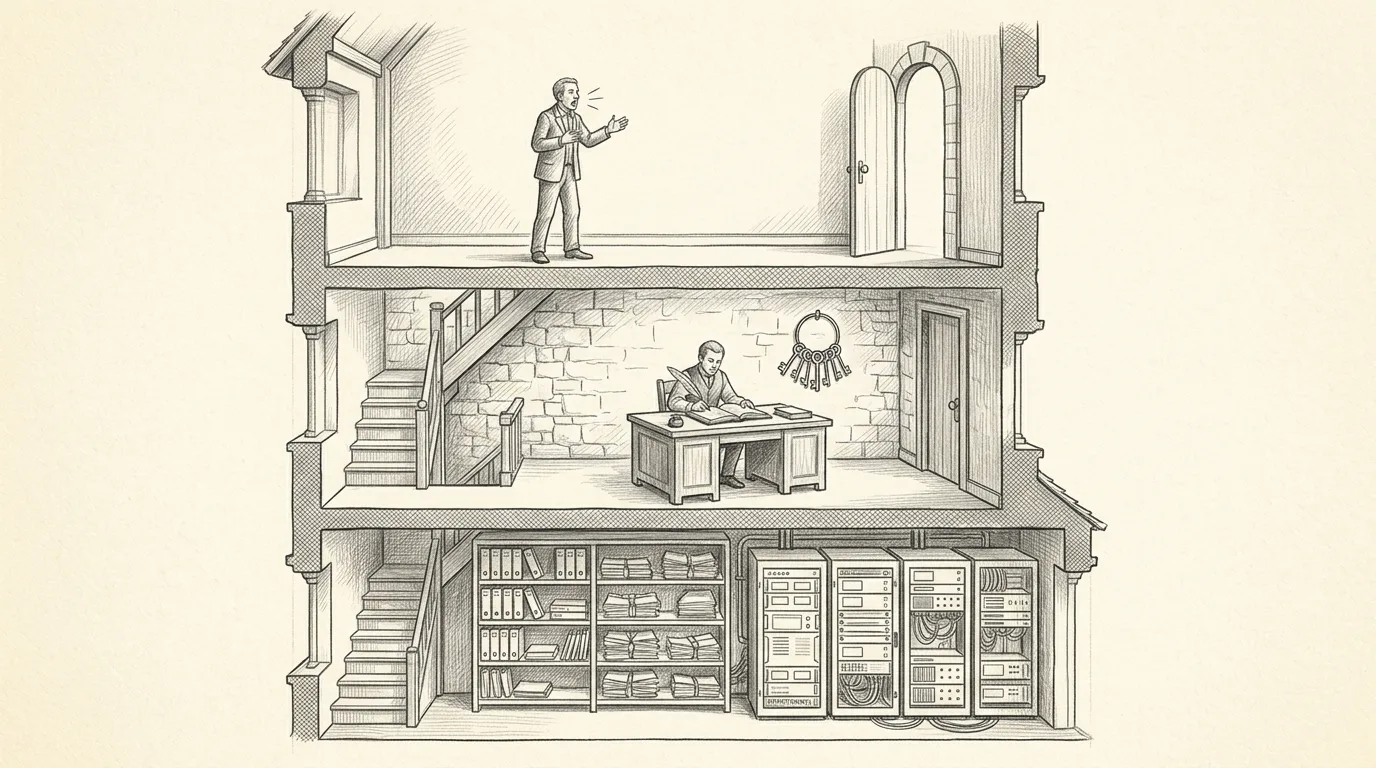
Our architecture follows from that. At the front sits ChatGPT, Claude, or another AI system. Behind it sits a governed operating layer that connects the intelligence to the organization. The Revuity MCP is the connector between an AI environment and approved business capabilities, and the Revuity Client Platform holds the operational context around it: roles, permissions, environment state, action policies, change management, outcomes, and an audit trail. The CRM, accounting, document, communication, and industry systems a company already uses can remain its systems of record, so nothing has to be replaced for them to take part in a more coherent whole.
The result we are designing toward is an employee who can ask what needs their attention today and receive an answer grounded in the organization's actual clients, commitments, and operating rules, which goes well beyond what a model happens to know. Ask for everything needed for tomorrow's client review, and the environment can identify the client, pull the relevant records, review recent activity, surface unresolved issues, draft an agenda, and stage the next actions for approval. The experience feels simple precisely because the system beneath it was built with care.
The durable asset is not the model
Models will improve, vendors will change, and today's leading interface may not be next year's. A business whose entire AI strategy rests on one provider has taken on a strategic risk it may not have priced.
So we build AI environments around the business, and we avoid rebuilding the business around a particular AI product. A company's workflows, rules, institutional knowledge, permissions, relationships, and history last longer than any model that interprets them, and that accumulated context is the part worth protecting. It is why Revuity stays platform-neutral wherever possible, so a company can take advantage of better intelligence without reconstructing its operating environment each time the technology moves. The intelligence will evolve and the operating system remains.
From applications to operational infrastructure
Traditional software bundled several kinds of value together: the interface, the database, the workflow, the rules, the reporting, the actions. AI is beginning to pull those layers apart. A company can keep its CRM without every employee living inside it, keep its payroll platform while people ask questions in plain language, and keep its logistics system executing transactions that customers start through an assistant.
That changes what makes software valuable. The systems that win will be the ones that can securely expose their capabilities to intelligent environments, and software that merely demands attention will matter less. It shapes how we approach building, too. Through CollabX, we can build applications and platforms designed from the start to serve both people and agentic systems, so they stop being isolated screens where someone has to carry information in and out by hand.

Governance matters more as AI does more
As AI becomes capable of more work, a business needs more control over how that work happens, and an AI system should never simply have open access to an organization. It has to know who is asking, what that person may see, which actions are permitted, what requires approval, which rules apply, which organization the information belongs to, what happened before, and whether the action can be audited.
Those are operational questions as much as technical ones, which is why our work brings together systems architecture, process design, software, AI, and governance. Intelligence without operational structure is unreliable, and structure without intelligence leaves much of the opportunity unused. The value comes from combining them.
Where this leads
People will spend less time navigating software and more time expressing intent. AI systems will interpret that intent, and software will supply the data, rules, transactions, and infrastructure needed to fulfill it. Organizations will need an operating layer that joins those worlds, and that is where Revuity works: designing AI environments around businesses, designing the operational systems underneath them, building software that can take part, and establishing the governance that makes it responsible to use.
We are not trying to predict which interface wins. We are building for businesses that will need to work across all of them, because the interface may change and the intelligence will keep improving, while the business still has to run.
Two ways to start
If you want AI that works inside your business, explore AI Environments. We design the environment around how your organization actually runs, with the roles, rules, and approvals built in, so your people can ask for work and get answers grounded in your own operation.
If you want software built for people and agents from day one, see CollabX. It is how Revuity builds applications and platforms that serve both your team and the AI systems working beside them.
Frequently asked questions
- What does it mean that AI is becoming the new front door for business software?
- It means people increasingly start work by asking an AI system such as ChatGPT or Claude to do something, like prepare a client briefing or find accounts that need follow-up, instead of opening a specific application. The AI works across many systems at once, and the applications become infrastructure behind it.
- Do businesses still need their CRM, accounting, and other systems if AI becomes the interface?
- Yes. Those systems usually remain the systems of record, and they matter more because an AI environment depends on accurate, well-governed data and rules. Nothing has to be replaced for them to take part.
- Why does connecting an AI model to a business not make it an intelligent business?
- Most organizations have fragmented information, processes that live partly in software and partly in people's heads, inconsistent permissions, and workflows that cross several systems. Connecting a model to that environment gives the same operational disorder a faster way to be found. The business has to be made understandable and operable first.
- What is an operating layer behind an AI interface?
- It is the governed layer between the AI and the business. At Revuity it includes the Revuity MCP, which connects an AI environment to approved business capabilities, and the Revuity Client Platform, which holds roles, permissions, environment state, action policies, change management, outcomes, and an audit trail.
- Why does AI governance matter more as AI does more work?
- An AI system should never have open access to an organization. It has to know who is asking, what that person may see, which actions are permitted, what requires approval, which rules apply, which organization the information belongs to, what happened before, and whether the action can be audited.
- Should a business build its AI strategy around one AI provider?
- No. Models and vendors change. The durable asset is the business's own workflows, rules, knowledge, permissions, and history. Revuity builds AI environments around the business and stays platform-neutral wherever possible, so a company can adopt better intelligence without rebuilding its operating environment.
- What is CollabX?
- CollabX is how Revuity builds applications and platforms that are designed from the start to serve both people and agentic systems, so they are not isolated screens where someone carries information in and out by hand.