Cookies
We use one analytics cookie (Google Analytics) to understand which pages are useful. No ads, no reselling, and declining changes nothing about how the site works. Privacy Policy
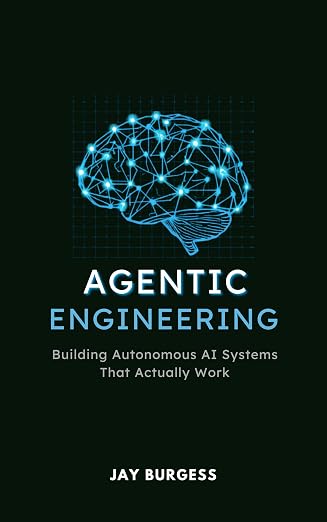
Agentic Engineering
Building autonomous AI systems that actually work. Architecture, guardrails, and the patterns that make agents reliable in production.
About this book
The model isn't the hard part. The architecture is.
Every AI demo works. Most production deployments fail. The reason isn't the model — it's the absence of the architecture around it. Boundaries that don't hold. Contracts that don't exist. Failure modes nobody planned for. Observability that won't survive a 3am incident. Evaluation pipelines that were never built.
Drawing on two years of building agentic systems in a highly regulated, audit-driven environment — where "mostly works" gets you an audit finding, not a product review — Jay Burgess lays out the engineering disciplines that separate demos from production-grade autonomous systems.
Who this book is for: engineering leaders, solutions architects, senior engineers, and AI practitioners who have moved past the demo phase and need to ship systems that hold up under real workloads, real data, and real scrutiny. If you've been told the answer is a better prompt or a bigger model and you suspect that's not it — this book is the other answer.
What's inside
- The five core disciplines every agentic system needs, and why they have to be applied in order
- The SHIELD framework for boundary design — six pillars of architectural enforcement that work where prompts fail
- The ATFAA threat taxonomy — nine failure modes across five domains, each with its architectural response
- The PSB protocol — Plan, Setup, Build — the three-phase workflow that prevents the rework spiral most teams get trapped in
- How to design memory architecture that doesn't fall into belief reinforcement loops
- The Senior Engineering Paradox — why agents need experienced humans more than ever, and what that means for hiring
- The six levels of autonomy organizations move through, and why most teams that think they're at Level 4 are actually at Level 2
- How to design and operate multi-agent systems without drowning in coordination overhead
Product details
About the author