
Is the work working?
A business can look fine from the outside while the important work slows down, disappears between handoffs, depends on the wrong people, or becomes hard to manage. We call that broken work. Revuity Systems studies how a business actually works and builds what makes it easier to run.
A few signs the work is quietly working against you.
Important work lives in someone's head.
If they're out, the work stalls, or it gets done differently by whoever picks it up.
Requests move between tools, inboxes, and people with no clear owner.
Something is always "in progress" somewhere, but no one can say exactly where, or who's on it.
Teams spend too much time checking status or following up.
Coordination becomes its own job, on top of the actual job.
Work gets repeated because no one can see what already happened.
The same question gets answered twice, the same fix gets rebuilt, and the lessons never add up.
Growth is exposing friction that used to be manageable.
What worked at a smaller size is now the thing slowing everything else down.
The workaround that gets you through today often becomes the constraint you have to work around tomorrow.
When important work depends on memory, manual follow-up, disconnected tools, or a few people holding everything together, the cost compounds as the business grows.
People spend hours coordinating work instead of doing it.
More volume requires more people because the system isn't carrying enough of the load.
Leaders find out something is wrong after the delay, customer issue, or missed number.
The business becomes dependent on the people who know how everything really works.
You're already paying for the system you haven't built. The question is whether the current cost is worth continuing to carry.
What changes when the work works.
People know what happens next.
Work moves without someone constantly pushing it forward.
Information follows the work.
People can see what happened, what is happening, and what needs attention.
Knowledge belongs to the business.
Important work doesn't disappear when one person leaves.
Growth doesn't automatically mean more coordination.
The system absorbs more of the complexity.
Leaders can manage the business instead of chasing it. Problems become visible early enough to do something about them.
That is what Revuity Systems means when we say: we make work work.

Start with the work.
Starting is short. Describe how the work moves today, where it gets difficult, and what that is costing or holding back. You don't need to know what the solution is. Starter is built to work that out with you.
If the work needs more than Starter, Teams and Custom are the two upgrades. If it doesn't, you will know that too.
Tell us what's going on
In your own words, in the chat or as you set up Starter. No need to name a solution.
Set up your operating environment
Starter is bought online with no sales call. It turns what you tell us into an AI Operating Environment built around how your business works.
Add help only if the work needs it
Teams and Custom are the two upgrades, each at its full price.

We use the leading AI models the way a careful engineering team would: reviewed, wired into the system, and given sensible guardrails.
Set up your own operating environment.
Starter is $299, bought online, with no sales call.
Talk it through with Gloria.
Describe what's happening in a couple of messages. Gloria can help you organize what you're seeing and point you to the right next step.
What happens when the person who knows leaves?
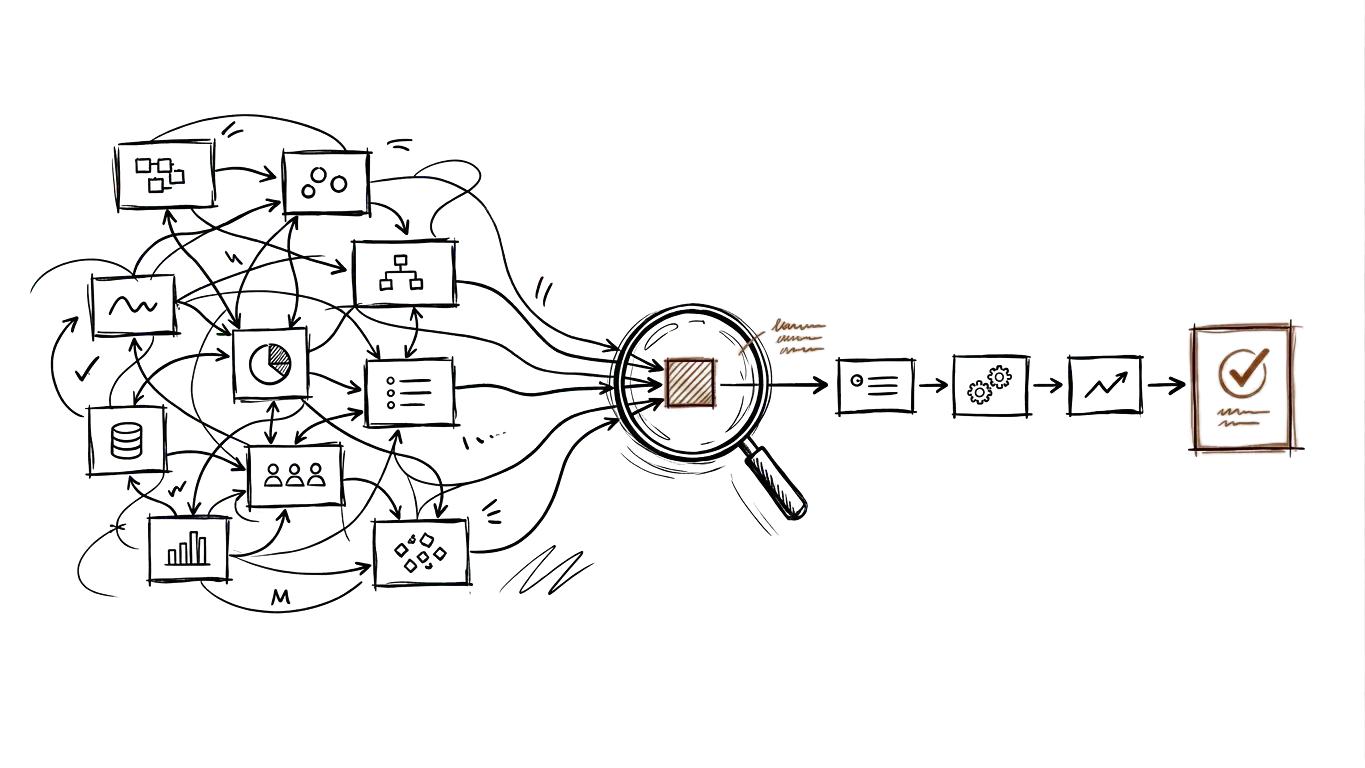
The Company Manual Nobody Writes
Most companies don't intentionally build around tribal knowledge, it accumulates one workaround, exception, and undocumented decision at a time, until the business depends on knowledge it doesn't actually own. Our field guide to turning operating knowledge into something the business can actually keep, improve, and use.
You don't have to wait until it breaks.
Most operational problems don't arrive as emergencies, they show up first as extra steps, repeated questions, manual checks, workarounds, delays, and people saying "that's just how we do it."
Those are often the cheapest moments to fix them. If you're already noticing the friction, that's enough reason to start.
More on why work stops working.
The Flow Lens: Why Work Stops
A team can be moving fast while the work itself barely moves. Flow efficiency shows you the waits, handoffs, and approval rules that keep complex operations from reaching the finish line.
8 min read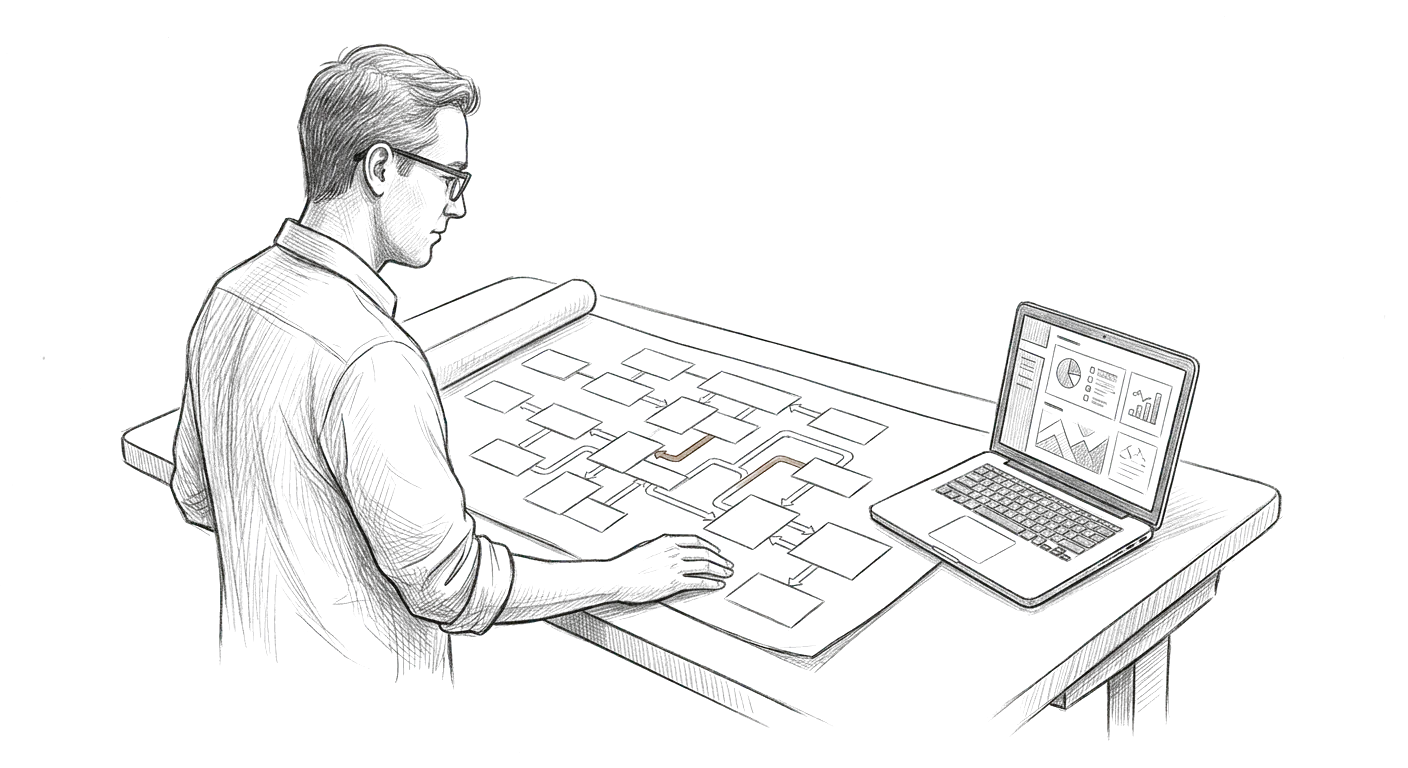
From Operational Problems to Working Systems: An Applied Framework for Forward Deployed Engineering
Most technology projects that disappoint work fine technically, and still fall short because the solution was chosen before anyone understood the operating problem. Here's an eight-layer framework for tracing a business problem all the way to a measured result.
14 min read