Cookies
We use one analytics cookie (Google Analytics) to understand which pages are useful. No ads, no reselling, and declining changes nothing about how the site works. Privacy Policy
Landscaping Company
Cut it. Design it. Keep the account.
Maintenance contracts = predictable revenue.
Complete business
$6,900
or $500 down, then $581.82/mo for 11 months
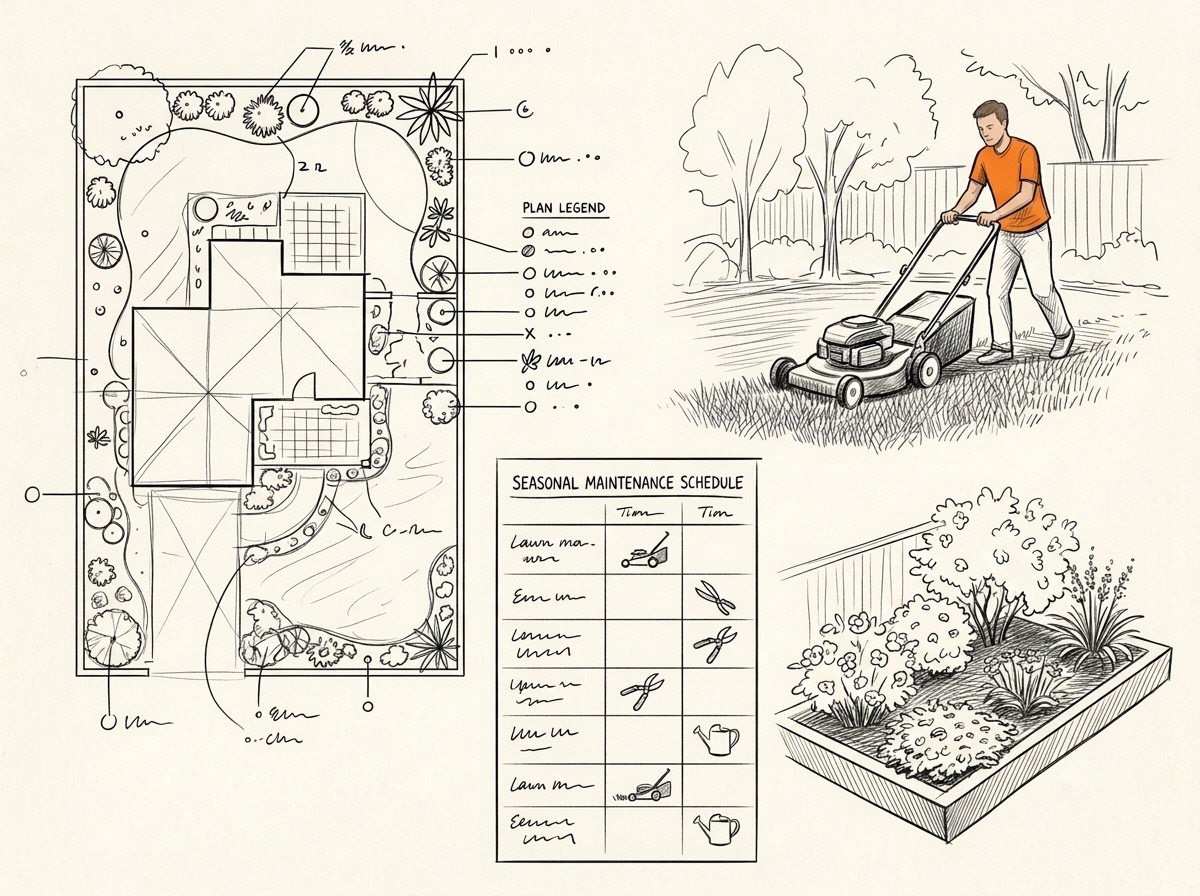
You already know how to run a crew. The harder part is building the business system around the work.
A landscaping company has to generate demand, qualify jobs, schedule site assessments, quote accurately, route crews efficiently, bill for maintenance contracts, collect payment, manage seasonal transitions, and eventually coordinate additional crews and equipment. If those pieces are disconnected, the owner becomes the system. Landscaping Company gives you the operating infrastructure for running them together.
Executive Summary
A ready-to-launch operating system for building and running a landscaping company. Customer acquisition, site assessment, crew routing, seasonal scheduling, and maintenance-contract billing are designed to work as one connected business system.
One business. Six connected systems.
This isn't a website with some documents attached. We've designed the major systems a landscaping business needs to operate, from first quote request to a full recurring route.
Customer engine
Turn local searches and referrals into booked estimates.
The customer engine creates a repeatable path from a homeowner or property manager needing landscaping work to a scheduled site assessment and signed estimate.
Includes
- Landscaping company website
- Service and quote-request pages
- Property and service-request intake
- Site assessment scheduling
- Local search structure
- Review-generation workflow
- Service-area architecture
Local acquisition → quote request → site assessment → estimate → booking
Crew operation
Run the route without keeping every stop in your head.
A defined operating workflow moves every crew through the same sequence of stops, from dispatch to a documented, completed job.
Includes
- Route optimization
- Crew dispatch and daily job lists
- Site arrival and check-in
- Service execution checklist by property type
- Job status tracking
- Completion documentation
- Exception and callback protocol
Route optimization → crew dispatch → site arrival → service execution → completion
Revenue system
Turn signed contracts into predictable, collected revenue.
Contracts, billing, invoicing, and renewals operate as one workflow instead of separate spreadsheets, texts, and paper invoices.
Includes
- Contract templates and signing
- Recurring monthly billing
- Automatic invoicing
- Payment collection
- Account transaction history
- Renewal tracking
Contract signing → recurring billing → invoicing → payment collection → renewal
Seasonal scheduling system
Rebuild the route every season instead of reacting to it.
Landscaping demand shifts with the seasons. This system rebuilds crew assignments, equipment, and routes at each transition instead of leaving it to memory.
Includes
- Season-transition checklist
- Service plan updates by property
- Crew reallocation
- Equipment swap and readiness
- Route rebuild by season
- Seasonal upsell triggers: spring cleanup, fall cleanup, snow removal
Season transition → service plan update → crew reallocation → equipment swap → route rebuild
Account growth system
Build route density instead of chasing scattered jobs.
Growth comes from adding accounts near existing stops, not from spreading thinner across town. This system targets, converts, and retains accounts by neighborhood.
Includes
- Neighborhood prospecting
- Route density targeting
- HOA and property management outreach
- Contract conversion workflow
- Client onboarding
- Renewal and referral outreach
Neighborhood prospecting → route density targeting → contract conversion → onboarding → renewal outreach
Operating infrastructure
Know what's happening on every route without being on every route.
As the business grows from one crew to several, the owner needs visibility into jobs, accounts, and money without personally supervising every stop.
Includes
- Operating procedures and SOPs
- Job and revenue dashboards
- Customer and contract records
- Business KPIs
- Startup and crew economics
- 90-day launch plan
- Second-crew hiring and scaling plan
Data capture → dashboards → review → decision → adjustment
The route should increasingly run through the system, not through the owner's memory.
The infrastructure behind the business
Instead of presenting this as six unrelated deliverables, everything maps to the operating system.
Your brand. Your customers. Your business. Revuity provides the operating system underneath it.
or $500 down, then $581.82/mo for 11 months
The problem
Most landscapers underprice their services and have no margin to hire or grow
Without maintenance contracts, revenue is unpredictable: busy in spring, dead in winter
No professional website means losing bids to competitors who show up in Google search
Route inefficiency wastes hours every day: wrong sequence, wrong density, wrong pricing per stop
No brand means competing purely on price against every operator with a mower
Scaling from solo to crew fails without documented systems for quality and communication
Design the business before the business gets busy.
Landscaping Company gives each major part of the operation a defined place. Customer demand enters through a system. Jobs move through a system. Crews move through a system. Money moves through a system. Information stays attached to the customer, property, and season that created it. That means growth doesn't have to depend on the owner remembering everything.
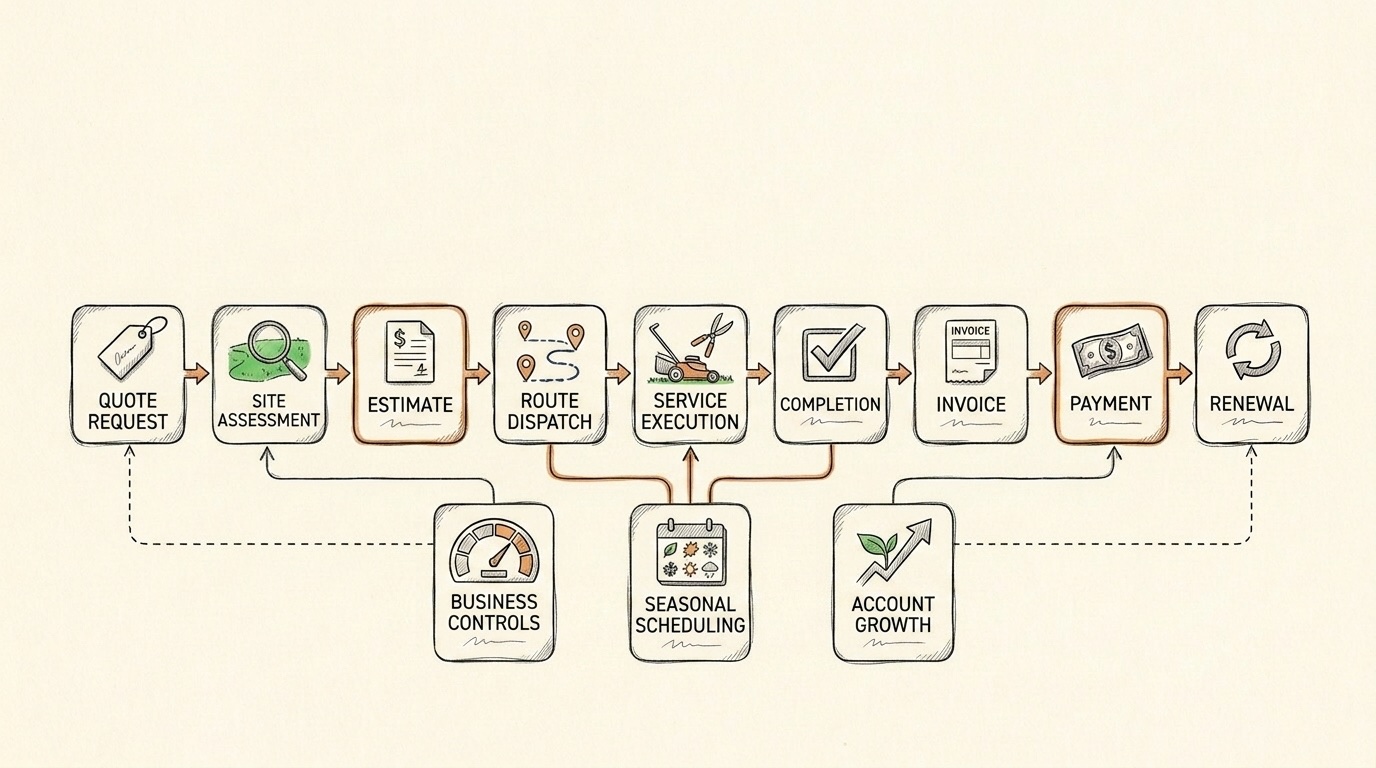
Quote request → Site assessment → Estimate → Route dispatch → Service execution → Completion → Invoice → Payment → Renewal
How the business makes money
Residential revenue
Recurring maintenance visits and seasonal services generate predictable per-property revenue with minimal reacquisition cost.
Commercial and HOA revenue
Multi-property contracts with HOAs and property managers add volume and stability that residential accounts alone cannot match.
Revenue expansion
As route density grows, capacity can expand through additional crews, equipment, and adjacent service lines like design or irrigation.
The growth path
Solo operator → booked route → recurring maintenance contracts → additional crew → multi-crew operation
Who this is built for
Target Customers
Homeowners in suburban neighborhoods who outsource lawn maintenance
HOAs with common area maintenance requirements
Commercial property managers with multi-property contracts
Rental property owners who need consistent maintenance for tenant satisfaction
New construction developments needing ongoing landscape maintenance
Corporate campuses and office parks with grounds maintenance budgets
Why this business exists
Maintenance contracts are the engine of landscaping profit: one account worth $200/month generates $2,400/year with near-zero reacquisition cost
Route density is the key variable in landscaping profitability. 8 accounts on one street is more valuable than 8 accounts spread across town
HOA and property management accounts provide volume and stability that residential one-offs cannot match
Local SEO in landscaping is still underutilized, most operators have no website or a poor one
The seasonal model creates natural upsell moments: spring cleanup, fall cleanup, irrigation startup, snow removal
Start with infrastructure instead of building it while chasing your first contract.
How customers request a quote: decided
How site assessments are scheduled: decided
How estimates are priced: decided
How maintenance contracts are structured: decided
How billing and invoicing work: decided
How routes are built and sequenced: decided
How the season transitions are managed: decided
How you pursue HOA and commercial accounts: decided
How contracts renew: decided
How a second crew gets added: decided
From purchase to operating business
Fit
Make sure the business fits you. We review your target service area, crew size, intended services, target customers, and operating goals.
Configure
Make the system yours. We configure the business infrastructure around your brand, service area, pricing, service menu, and operating requirements.
Deploy
Stand up the operation. Your digital infrastructure and operating software are deployed. Core workflows: customer intake, quoting, scheduling, billing, and business controls are configured.
Launch
Put the system into operation. Activate local acquisition, Google Business Profile, quote-request capture, and neighborhood outreach using the launch playbook.
Operate
Run the business through the system. Jobs, contracts, quotes, routes, invoices, and payments move through defined workflows.
Grow
Add capacity without reinventing the business. Use the documented operating model to add accounts, routes, crews, and equipment while preserving how the business is supposed to run.
It's your business.
Start your Landscaping Company business.
$6,900
or $500 down, then $581.82/mo for 11 months