Cookies
We use one analytics cookie (Google Analytics) to understand which pages are useful. No ads, no reselling, and declining changes nothing about how the site works. Privacy Policy
EventSpark
You run the events. We deploy the platform.
Registration, attendees, and billing, systemized.
Complete business
$6,900
or $500 down, then $581.82/mo for 11 months
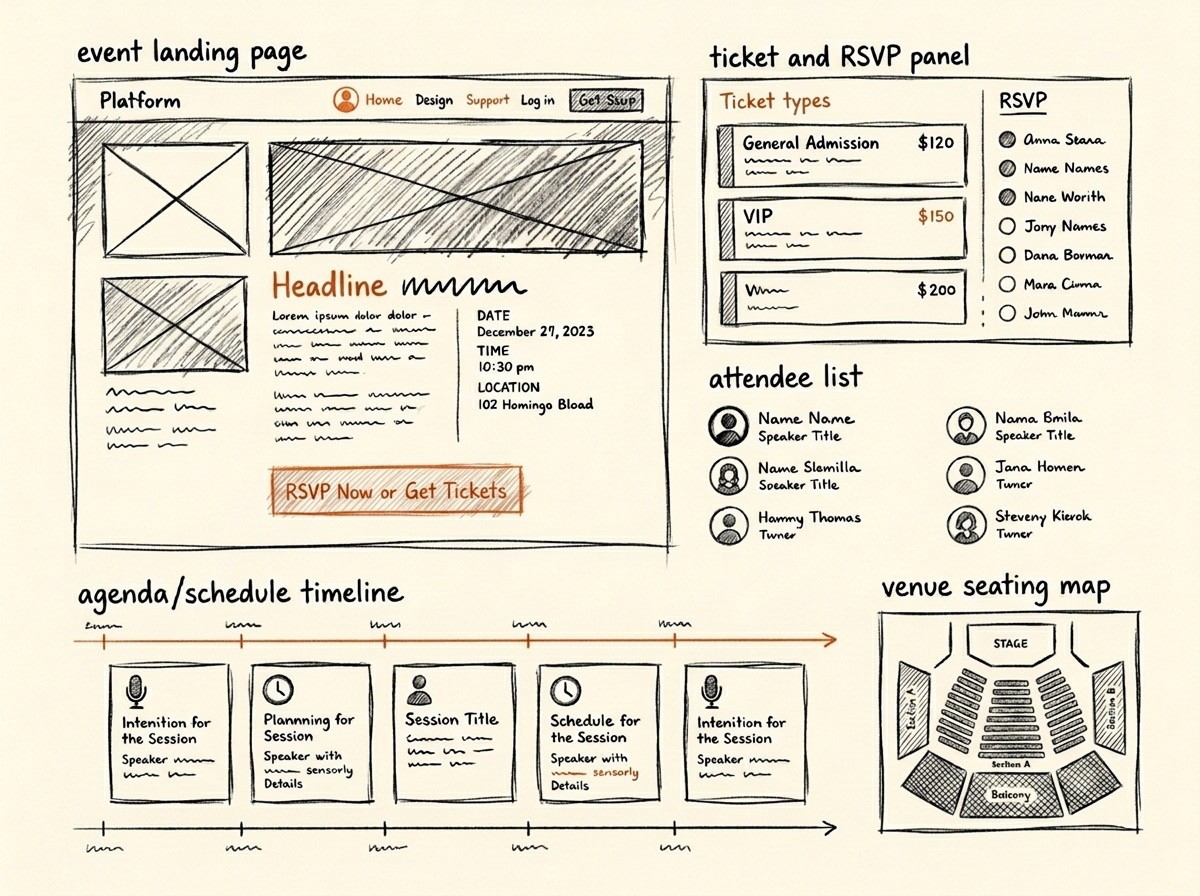
You already know how to run a room. The harder part is building the business system around the events.
An event organizer has to build registration pages, sell tickets, track attendees, run check-in on event day, invoice sponsors, collect payment, follow up after each event, and eventually manage a full calendar of recurring events and sponsor accounts. If those pieces are disconnected, the organizer becomes the system. EventSpark gives you the operating infrastructure for running them together.
Executive Summary
A ready-to-launch operating system for building and running an event business. Registration, ticketing, attendee tracking, event-day operations, and sponsor revenue are designed to work as one connected system, not five disconnected tools. You run the events. The system runs registration, billing, and follow-up around them.
One business. Six connected systems.
This isn't a website with some documents attached. We've designed the major systems an event business needs to operate, from first ticket sale to a recurring calendar of sponsored events.
Registration engine
Turn interest into a completed ticket, every time.
The registration engine creates a repeatable path from someone finding your event to a confirmed ticket on their calendar.
Includes
- Branded event pages for every event
- Ticket tiers and pricing structure
- Branded checkout flow
- Automated confirmation emails
- Reminder sequences before the event
- Calendar sync for registered attendees
- Event page SEO structure
Event page build → Ticket tiers → Branded checkout → Confirmation and reminders → Calendar sync
Event-day operation
Run the room without losing track of who's in it.
A defined event-day workflow moves attendees from arrival to close-out the same way every time, regardless of event size.
Includes
- Check-in and badging workflow
- Session and capacity flow
- Real-time capacity monitoring
- On-site support procedures
- Exception and no-show handling
- Close-out and reconciliation checklist
Check-in and badging → Session flow → Capacity monitoring → On-site support → Close-out
Revenue system
Turn every ticket and sponsorship into controlled revenue.
Ticket sales, sponsor invoicing, payment processing, and reconciliation operate as one workflow instead of a mix of platforms and spreadsheets.
Includes
- Ticket sales processing
- Sponsor invoicing
- Payment processing
- Payout reconciliation
- Refund and cancellation handling
- Revenue reporting by event
Ticket sales → Sponsor invoicing → Payment processing → Payout reconciliation → Refund handling
Attendee management
Know who's coming, who came, and who to invite back.
Attendee data is captured once and used across the full event lifecycle, from signup through the next event.
Includes
- Signup and registration capture
- Attendee segmentation
- Pre-event communication sequences
- Attendance tracking across events
- Post-event follow-up workflow
- Repeat-attendee identification
Signup capture → Segmentation → Pre-event communication → Attendance tracking → Post-event follow-up
Sponsor growth system
Build a second revenue engine alongside ticket sales.
Sponsorship is treated as a repeatable sales process, not a one-off ask before each event.
Includes
- Sponsor prospecting workflow
- Sponsorship package structure
- Renewal outreach process
- Sponsor account management
- Repeat event booking process
- Sponsor reporting and delivery
Prospecting → Sponsorship packages → Renewal outreach → Account management → Repeat event booking
Operating infrastructure
Know what's happening across events without being everywhere.
As the calendar grows, the organizer needs visibility into registrations, revenue, attendees, and sponsors across every event.
Includes
- Software and workflow documentation
- Data model connecting events, attendees, and sponsors
- Operating dashboards
- SOPs for event execution
- 90-day launch playbook
- Recurring-calendar scaling plan
Data capture → Dashboards → Review → Decision → Adjustment
The business should increasingly run through the system, not through the organizer's memory.
The infrastructure behind the business
Instead of presenting this as five unrelated deliverables, everything maps to the operating system.
Your brand. Your attendees. Your business. Revuity provides the operating system underneath it.
or $500 down, then $581.82/mo for 11 months
The problem
Organizers stitch together Eventbrite, Mailchimp, Stripe, and spreadsheets, hours of admin per event instead of building the business
Ticketing platforms take 6–8% of every paid ticket, taxing the exact revenue the business runs on
Attendee data is scattered across tools, so organizers can't see who returns, who lapsed, or who to invite next
Each event starts from zero: no community hub means no compounding audience between events
Generic registration forms undercut the brand and depress ticket conversion before the event begins
Without systemized follow-up, attendees vanish after the event, and every seat has to be re-sold from scratch
Design the business before the business gets busy.
EventSpark gives each major part of the operation a defined place. Registration enters through a system. The event day runs through a system. Sponsor revenue moves through a system. Attendee data moves through a system. Information stays attached to the event, attendee, and sponsor that created it. That means growth doesn't have to depend on the organizer remembering everything.
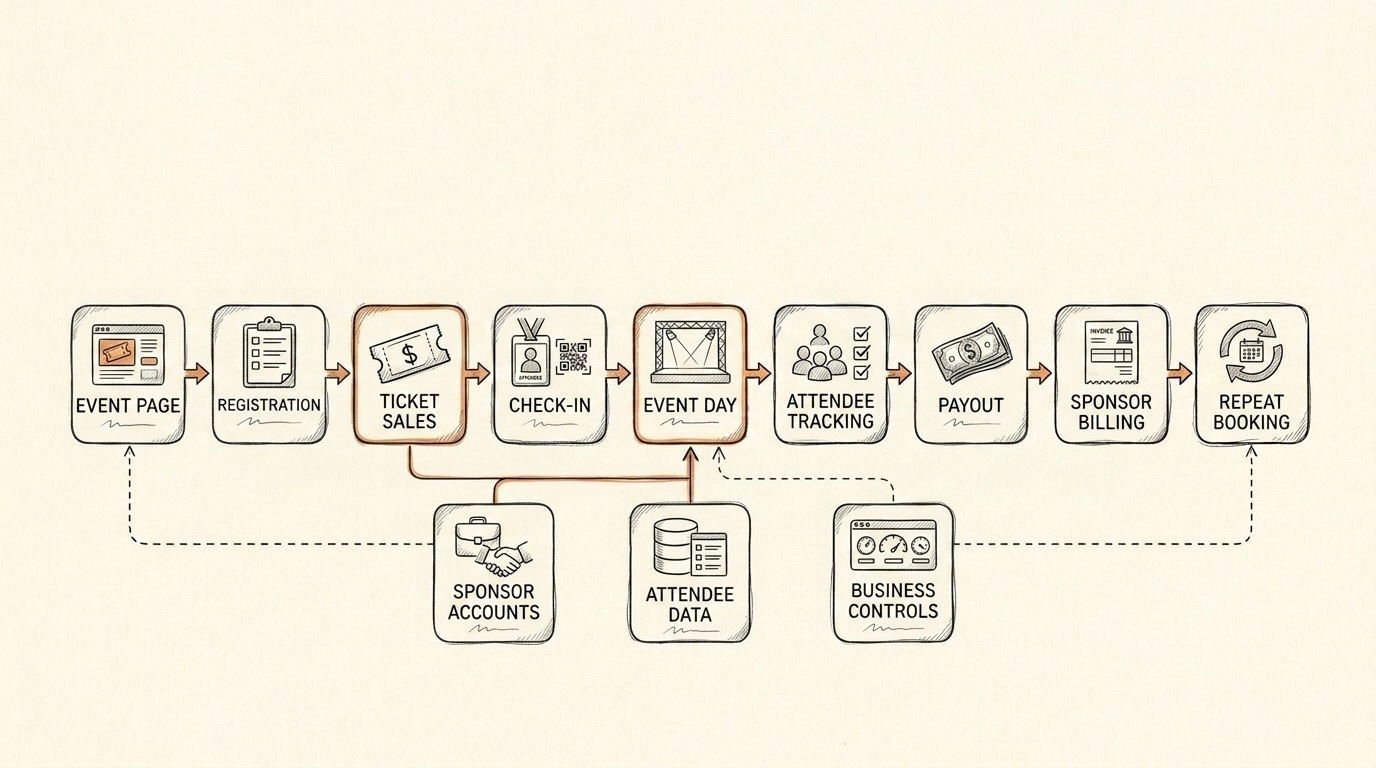
Event page → Registration → Ticket sales → Check-in → Event day → Attendee tracking → Payout → Sponsor billing → Repeat booking
How the business makes money
Ticket revenue
Paid registration for workshops, conferences, and recurring event series generates direct transaction revenue with every event.
Sponsor revenue
Sponsorship packages create a second revenue engine tied to audience size and engagement, independent of ticket price.
Membership revenue
Community memberships convert your most engaged attendees into recurring monthly revenue between events.
The growth path
Solo organizer → ticketed events → sponsored events → recurring event calendar → community membership base
Who this is built for
Target Customers
Workshop leaders and trainers running paid in-person and online sessions
Independent conference and summit organizers building an annual event brand
Community builders running recurring meetups, dinners, and networking series
Coaches and educators running cohort programs and live events
Professional associations and chambers hosting member events
Niche-scene organizers in fitness, food, tech, or creative work, turning a following into a business
Why this business exists
Recurring event series are the strongest model in events. The same audience returns, and revenue compounds, but only with attendee tracking across events
Percentage-based ticketing platforms take 6–8% of every sale; owning your platform keeps ticket revenue where it belongs
Sponsors pay for engaged, measurable audiences. Attendee data and retention analytics are what turn a sponsor pitch into a contract
Community memberships convert your best attendees into recurring monthly revenue between events
Organizers with branded registration, clean check-in, and professional follow-up win repeat attendees. Polish is retention
Start with infrastructure instead of assembling it while you're trying to sell tickets.
How attendees register: decided
How ticket tiers are structured: decided
How checkout and confirmations work: decided
How check-in and badging run: decided
How capacity is monitored on event day: decided
How ticket revenue and sponsor invoices are processed: decided
How payouts are reconciled: decided
How attendees are segmented and followed up with: decided
How sponsorship packages are built and renewed: decided
How the operation is documented and scaled: decided
From purchase to operating business
Fit
Make sure the business fits you. We review the events you want to run, your audience, your market, and your operating goals.
Configure
Make the system yours. We configure the business infrastructure around your brand, event types, ticket pricing, and sponsor packages.
Deploy
Stand up the operation. Your digital infrastructure and operating software are deployed. Registration, ticketing, attendee tracking, and billing workflows are configured.
Launch
Put the system into operation. Activate registration pages, ticket sales, and sponsor outreach using the launch playbook.
Operate
Run the business through the system. Registrations, tickets, attendees, sponsors, and payments move through defined workflows.
Grow
Add capacity without reinventing the business. Use the documented operating model to add events, sponsors, and community members while preserving how the business is supposed to run.
It's your business.
Start your EventSpark business.
$6,900
or $500 down, then $581.82/mo for 11 months